Encinitas, CA, Feb. 25, 2026 (GLOBE NEWSWIRE) — Disclaimer: This article is for informational purposes only. It is not medical advice. Weight management concerns should be evaluated by a qualified healthcare professional. Compounded GLP-1 medications are prescription medications that require evaluation by a licensed clinician. Prescription approval is not guaranteed. If you purchase through links in this article, a commission may be earned at no additional cost to you.
As interest in prescription GLP-1 weight loss treatment through telehealth platforms continues to expand in 2026, consumers researching compounded semaglutide and tirzepatide options encounter a rapidly shifting regulatory landscape. One platform that comes up frequently in that research process is Sprout Health GLP-1 Weight Loss — a telehealth service operated by Sprout Health Partners LLC that connects consumers with licensed clinicians and partner compounding pharmacies.
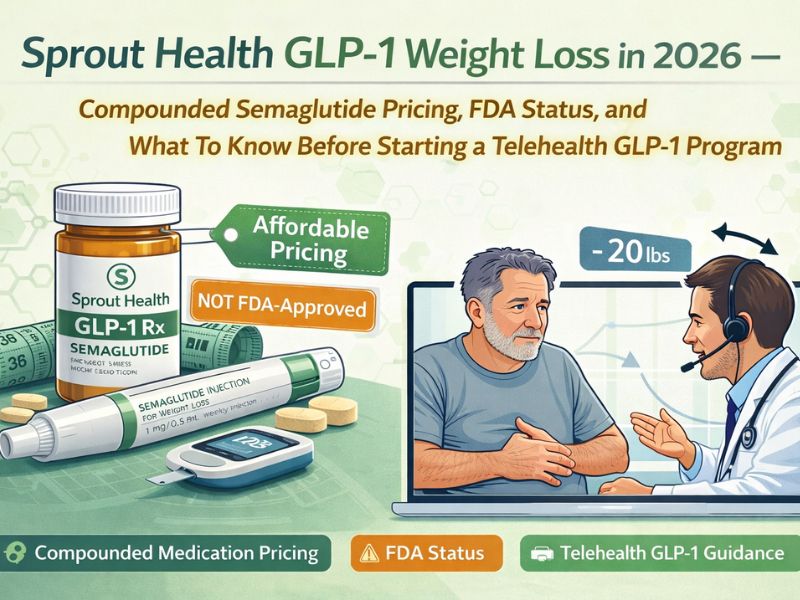
Before starting any compounded GLP-1 telehealth program, there are regulatory, clinical, and platform-level details worth understanding clearly. This article covers those details — not as a recommendation, but as the kind of informed overview that helps consumers ask the right questions and verify the right information before making a decision that involves their health.
A previously released industry analysis examining compounded GLP-1 telehealth access and pricing transparency provided an initial framework for evaluating platforms in this category. This article builds on that foundation with updated regulatory context and a focused informational overview of the Sprout Health platform specifically.
This article is independently prepared based on publicly available information and does not represent official statements issued by Sprout Health Partners LLC.
Consumers can review the company’s disclosures directly and view the current Sprout Health offer (official Sprout Health page) for the most up-to-date program details.
What This Product Is: Regulatory Classification First
This is the most important starting point, and it warrants careful reading regardless of which compounded GLP-1 product or telehealth platform may be under consideration.
Sprout Health GLP-1 Weight Loss is a telehealth platform — not a healthcare provider, pharmacy, or drug manufacturer — that connects consumers with independent licensed clinicians and partner compounding pharmacies for potential access to compounded semaglutide and compounded tirzepatide medications.
Based on publicly available disclosures on the company’s website, Sprout Health Partners LLC operates the technology platform at joinsprouthealth.com. The platform provides the intake process, customer support, subscription management, and coordination between patients, providers, and pharmacies. The platform itself does not prescribe medications or make clinical decisions.
Here is the key classification distinction: compounded semaglutide and compounded tirzepatide are not FDA-approved finished products. They have not been reviewed by the FDA for safety, effectiveness, or quality as finished formulations. These compounded medications are not generic versions of FDA-approved branded medications such as Ozempic, Wegovy, Zepbound, or Mounjaro. Compounded drugs are prepared by pharmacies based on individual prescriptions.
What Compounded GLP-1 Medication Means Under FDA Framework
If you are researching compounded GLP-1 treatments for the first time, you probably have questions about what “compounded” actually means in a regulatory context. Here is the straightforward explanation.
Pharmacy compounding is the practice of creating customized medications tailored to individual patient needs. Compounding pharmacies operate under federal and state regulations, and the practice is overseen by state pharmacy boards. Compounded medications are legally prescribed and dispensed in the United States when prepared by licensed pharmacies under the direction of a licensed prescriber.
The regulatory difference from FDA-approved drugs is specific: FDA-approved medications such as Wegovy and Ozempic undergo clinical trials evaluating the finished product’s safety and efficacy as a complete formulation. Compounded medications use active pharmaceutical ingredients but are not required to undergo separate clinical trials for the specific compounded version.
This distinction has become particularly significant in early 2026. According to public FDA communications, the semaglutide drug shortage has been officially resolved as of February 2026. Under the Federal Food, Drug, and Cosmetic Act, compounding pharmacies are generally prohibited from producing drugs that are essentially copies of commercially available FDA-approved products. An exception existed during the period when semaglutide appeared on the FDA drug shortage list. With the shortage resolved, that exception has narrowed significantly.
According to public FDA communications updated in early 2026, the agency has stated it intends to prioritize enforcement against certain mass-marketed non-FDA-approved GLP-1 products. The FDA has distinguished between mass-marketed compounded products and patient-specific compounding performed under Section 503A of the FD&C Act, which may remain permissible in narrow circumstances where a patient’s medical needs cannot be met by an FDA-approved drug.
This does not mean compounded medications are categorically unavailable. It means the regulatory pathway is narrower than it was in prior years, and consumers should be aware of that shift when making informed decisions about their treatment options.
How the Telehealth Structure Works: Platform, Clinician, and Pharmacy
One of the most common points of confusion with telehealth prescription services is understanding who actually does what. With Sprout Health — and with most telehealth prescription platforms — there are three separate entities involved, and knowing the distinction between them matters more than most people realize.
Sprout Health Partners LLC operates as the telehealth platform. According to the company’s terms of use, Sprout Health itself is not a healthcare provider. The platform provides the technology infrastructure, customer service, subscription management, and coordination that facilitates the telehealth experience. Sprout Health does not diagnose conditions, write prescriptions, or make clinical treatment decisions.
Licensed Medical Providers are independent healthcare professionals who review patient-submitted medical information and independently determine whether a prescription is clinically appropriate. The company states that these clinicians operate through MD Integrations (MDI), a physician network. In certain states, synchronous telehealth visits are required by state law. According to the company’s disclosures, MDI doctors provide synchronous visits in AR, CO, ID, IL, IN, MD, MO, MT, NE, NY, OK, SD, VT, VA, and WI. The platform cannot guarantee that any individual will receive a prescription — that determination rests entirely with the evaluating clinician.
Licensed Partner Pharmacies compound and dispense medications based on prescriptions written by the independent medical providers. According to the company’s terms and conditions, Sprout Health partners with Foothills Pharmacy and Promise Pharmacy. According to publicly available third-party listings, Sprout Health holds LegitScript certification, which involves verification of legal compliance, provider credentials, and medication sourcing practices.
This three-entity structure — platform, prescriber, pharmacy — is standard across telehealth prescription services. It exists to maintain appropriate separation between technology facilitation, clinical judgment, and pharmaceutical dispensing.
How the Enrollment Process Works
According to the company’s website, the telehealth access model operates through a structured multi-step process.
The platform begins with an online pre-qualification assessment that evaluates basic eligibility criteria. Following pre-qualification and plan purchase, consumers complete a detailed medical questionnaire. An independent licensed clinician reviews the questionnaire and determines whether prescribing compounded GLP-1 medication is clinically appropriate.
If a prescription is issued, the medication is prepared by one of Sprout Health’s partner compounding pharmacies and shipped to the consumer. The company states that the process from prescription to delivery typically takes five to seven business days.
According to the company’s Patient Services and Transparency section, services are available in the United States except: AL, AR, MS, LA, CA, and ND. Consumers should verify current state eligibility directly with the platform, as telehealth regulations may change.
What the Program Contains
According to the company’s website, Sprout Health’s weight loss program provides access to compounded semaglutide or compounded tirzepatide medications. Clinicians may prescribe compounded GLP-1 medications in different formulations when clinically appropriate. Consumers should confirm the specific formulation available for their state and prescription directly with the prescribing provider.
Semaglutide and tirzepatide are GLP-1 receptor agonists — a class of medications that act on natural hormone pathways in the body. Some formulations also act on the GIP (glucose-dependent insulinotropic polypeptide) pathway. Clinical research on the FDA-approved branded versions of these active ingredients includes the STEP-1 trial, which demonstrated mean weight reduction of approximately 14.9% with semaglutide over 68 weeks, and the SURMOUNT-1 trial, which showed tirzepatide achieving 16–22.5% weight reduction over 72 weeks.
Important research boundary: These clinical trial results were achieved with FDA-approved branded medications studied under controlled conditions with specific manufacturing processes, quality controls, and dosing protocols. These figures should not be interpreted as expected outcomes for compounded products, which have not undergone equivalent clinical trials and have not been reviewed by the FDA for safety, effectiveness, or quality as finished products.
The program also includes evaluations by a licensed medical provider, follow-up appointments, messaging access to a licensed clinician, and a four-week supply of medication with each monthly subscription. According to the company, treatment is positioned as part of a broader lifestyle approach that may include dietary and exercise guidance.
Delivery and Usage Details
According to the company’s website, once a prescription is issued, it is sent to the partner pharmacy within two business days of the patient completing the required medical form. The company states that orders are typically delivered within three to five business days after prescription approval and processing.
Because Sprout Health notes that some injectable medications may require refrigeration, consumers evaluating any shipped injectable medication may consider confirming storage and transit handling details with the dispensing pharmacy and prescribing clinician, especially if there are questions about temperature control during shipment.
Monthly subscribers receive a refill intake questionnaire after completing their third dose in a given cycle. A clinician reviews the refill intake before issuing a subsequent prescription. Dosage adjustments are determined by the assigned licensed clinician based on clinical assessment. Individual results with any GLP-1 medication may vary depending on factors including adherence to the prescribed treatment plan, individual metabolic response, lifestyle factors, dietary habits, and exercise patterns.
Pricing Disclosures
According to the company’s website at the time of this article:
Compounded Semaglutide is listed at $249 per month. Compounded Tirzepatide is listed at $299 per month. The company states that these prices include evaluations by a licensed medical provider, follow-up appointments, messaging access to a licensed clinician, a four-week supply of medication, and shipping.
The company states that the initial subscription price is honored for the duration of the subscription, even if dosage increases require additional medication in subsequent months. Sprout Health operates on a month-to-month subscription basis with no minimum contracts. Pricing, terms, and promotional offers are subject to change. Always verify current pricing directly on the official website before beginning treatment discussions.
Insurance and payment context: According to the company’s website, Sprout Health does not accept or bill insurance and accepts most forms of online payment. According to the company’s cancellation policy, orders may be canceled for a full refund before medication is processed by the partner pharmacy. Once a prescription is processed and sent to the pharmacy, refunds are not available.
Safety, Risks, and Limitations
Publicly available medical literature indicates that GLP-1 receptor agonists may be associated with side effects including nausea, vomiting, diarrhea, constipation, abdominal pain, and reduced appetite. Less common but more serious reactions have also been reported, including pancreatitis, gallbladder issues, kidney problems, and severe gastrointestinal symptoms.
Prescribing information for GLP-1 receptor agonists indicates that these medications should not be used by individuals with a personal or family history of medullary thyroid carcinoma or Multiple Endocrine Neoplasia syndrome type 2 (MEN 2).
Compounded medication-specific risks include potential variability in formulation, dosing errors associated with self-administration, and quality concerns that the FDA has identified as distinct from risks associated with FDA-approved products. The FDA has received reports of adverse events, some requiring hospitalization, that may be related to dosing errors with compounded injectable semaglutide products.
Telehealth limitations also apply to this model. A telehealth evaluation may not capture all relevant clinical information that would be available in an in-person examination. Consumers with complex medical histories, multiple medications, or significant comorbidities should discuss GLP-1 therapy with their primary care provider or specialist in addition to any telehealth evaluation. Compounded GLP-1 medications are not FDA-approved as finished products and have not been reviewed by the FDA for safety, effectiveness, or quality as finished formulations. Any decision to prescribe, dose, or continue therapy is made by the licensed clinician based on the patient’s medical profile.
What Consumers Commonly Verify
Consumers conducting due diligence on telehealth GLP-1 platforms often review the following verification categories before enrolling:
Business registration and entity verification: Sprout Health Partners LLC is the registered business entity, according to the company’s terms and conditions. The company’s terms identify Michigan as the governing law jurisdiction.
Clinician licensing and oversight: The company states that all prescribing clinicians are licensed medical providers operating through the MD Integrations physician network. Consumers may verify individual provider credentials through their state medical board.
Pharmacy licensing and certification: The company identifies Foothills Pharmacy and Promise Pharmacy as partner compounding pharmacies. LegitScript certification status can be verified through publicly available third-party listings.
Terms, refund policies, and subscription structure: The company’s refund policy states that prescription medications are non-refundable once processed by the partner pharmacy. Consumers are encouraged to review the complete terms and conditions before purchase.
Regulatory compliance status: Given the evolving regulatory landscape for compounded GLP-1 medications in 2026, consumers may wish to verify how the platform’s compounding model aligns with current FDA guidance and state pharmacy board regulations.
How This Category Compares to Other Access Models
Consumers exploring GLP-1 weight loss options in 2026 generally encounter three distinct access models, each with different regulatory status, cost structures, and clinical considerations.
FDA-approved branded medications through traditional healthcare: Products such as Wegovy, Ozempic, Zepbound, and Mounjaro have undergone comprehensive FDA review for safety, efficacy, and manufacturing quality. These carry specific FDA-approved indications and extensive clinical trial data. They are typically accessed through in-person or telehealth prescriber visits and filled at retail pharmacies. Costs may exceed $1,000 per month without insurance coverage.
Compounded GLP-1 medications through telehealth platforms: These platforms facilitate access to compounded semaglutide or tirzepatide prepared by licensed compounding pharmacies. Compounded medications are not FDA-approved as finished products. This model generally offers lower pricing but carries distinct regulatory and quality considerations.
In-person clinical weight management programs: These programs may combine FDA-approved GLP-1 prescriptions with comprehensive clinical oversight, nutritional counseling, and ongoing monitoring. They typically involve higher costs and require in-person visits but may provide a more thorough clinical evaluation.
No specific platform or model is presented as superior. Each carries distinct trade-offs in cost, convenience, regulatory status, and level of clinical oversight.
Evidence Boundaries
Consumers should understand the distinction between ingredient-level evidence and product-level evidence when evaluating any compounded GLP-1 offering.
Ingredient-level evidence exists for the active pharmaceutical ingredients semaglutide and tirzepatide. Clinical trials, including the STEP and SURMOUNT trial programs, have demonstrated significant weight reduction with FDA-approved branded formulations of these ingredients under controlled conditions.
Product-level evidence does not exist for compounded versions of these medications as prepared by compounding pharmacies. Compounded products have not undergone independent clinical trials establishing their safety, efficacy, or bioequivalence to the FDA-approved branded versions. The clinical outcomes observed in branded product trials cannot be assumed to apply identically to compounded formulations, which may differ in manufacturing processes, quality controls, excipients, and stability profiles.
Summary of Key Considerations
Sprout Health GLP-1 Weight Loss operates as a telehealth platform connecting consumers with licensed clinicians and partner compounding pharmacies for potential access to compounded semaglutide and tirzepatide medications. The platform is operated by Sprout Health Partners LLC.
Key considerations for consumers evaluating this platform include the non-FDA-approved status of compounded GLP-1 medications as finished products, the evolving regulatory environment in 2026 with increased FDA enforcement focus on compounded GLP-1 products, the platform’s pricing of $249 per month for compounded semaglutide and $299 per month for compounded tirzepatide, and the month-to-month subscription structure with no contracts.
Additional factors include the evidence boundary between clinical trial data on branded products and the absence of equivalent data on compounded formulations. Consumers are encouraged to consult with a licensed healthcare provider, review the platform’s terms and disclosures directly, and independently verify regulatory compliance status before making healthcare decisions.
Consumers interested in reviewing the platform’s current terms can view the current Sprout Health offer (official Sprout Health page) for the latest program and pricing information.
Contact Information
For questions about Sprout Health GLP-1 Weight Loss, according to the company’s website:
Sprout Health Partners LLC
Website: https://joinsprouthealth.com
Email: help@joinsprouthealth.com
Phone: +1 (833) 496-4020
Hours: According to the company, support is available Monday through Friday, 9:00 a.m. to 5:30 p.m. Mountain Time.
This informational overview was prepared by an independent digital publisher. The publisher may maintain a commercial relationship with the brand referenced. This article does not represent the views or editorial positions of Sprout Health Partners LLC.
Disclaimers
General Disclaimer: This article is for informational purposes only and does not constitute medical, financial, or professional advice. Individuals should consult a qualified healthcare provider before starting, stopping, or modifying any prescription medication regimen. If you purchase through links in this article, a commission may be earned at no additional cost to you.
Compounded Medication Notice: Compounded semaglutide and compounded tirzepatide are not FDA-approved finished products. They have not been reviewed by the FDA for safety, effectiveness, or quality as finished formulations. Compounded drugs are not generic equivalents of FDA-approved branded medications. Compounded medications should only be used when a patient’s medical needs cannot be met by an FDA-approved drug, as determined by a licensed healthcare provider.
FDA Regulatory Notice: As of February 2026, the FDA has resolved the semaglutide drug shortage and has stated its intent to prioritize enforcement against certain mass-marketed non-FDA-approved GLP-1 products. Consumers should verify the current regulatory status of compounded GLP-1 access with their healthcare provider and the prescribing platform. Regulatory status is subject to change.
Results Disclaimer: Individual results may vary. Weight loss outcomes depend on numerous factors including adherence to prescribed treatment, individual metabolic response, dietary habits, exercise patterns, and overall health status. No specific outcome is guaranteed.
Clinical Evidence Disclaimer: Clinical trial results cited in this article refer to FDA-approved branded medications studied under controlled conditions. These results cannot be directly attributed to compounded formulations, which have not undergone equivalent clinical evaluation.