Palm Beach Gardens, FL, April 11, 2026 (GLOBE NEWSWIRE) — This article contains affiliate links. If a subscription is purchased through these links, a commission may be earned at no additional cost to the buyer. This content is for informational purposes only and does not constitute financial, investment, or legal advice. Investing involves risk, including the potential loss of principal. Past performance does not guarantee future results. Consult a qualified financial advisor before making any investment decisions.
Weiss Ratings has released new analysis outlining its perspective on emerging healthcare cost pressures and broader economic risk factors. The report highlights a series of trends the firm identifies as increasingly relevant for investors evaluating market risk and defensive positioning in 2026.
The analysis reflects Weiss Ratings’ internal research perspective and is intended for informational purposes. The report outlines key elements of the analysis, the associated subscription offering, and considerations for investors evaluating the research framework. These developments are being evaluated in the context of recent economic shifts and upcoming policy and pricing cycles expected to influence financial conditions into late 2026.
The findings reflect trends that are increasingly being monitored within investment research discussions — particularly among adults approaching or in retirement who are actively reassessing portfolio protection strategies in light of rising systemic cost pressures. Full details, current pricing, and subscription terms are available on the official Weiss Ratings page, where readers can View the current Safe Money Report offer (official Weiss Ratings page) for the latest subscription details.
Individual investment results vary. Nothing in this article should be interpreted as personalized investment advice.
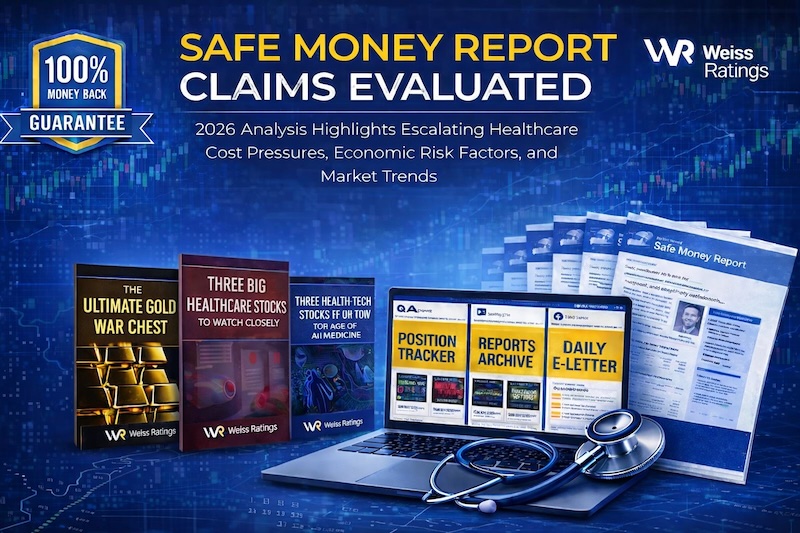
What Weiss Ratings Is and What Safe Money Report Covers
Weiss Ratings, LLC is a financial research publishing firm headquartered at 11780 US Highway 1, Palm Beach Gardens, FL 33408, founded by Martin Weiss, Ph.D. The company has published financial research and institutional ratings for several decades, covering stocks, ETFs, mutual funds, digital assets, banks, insurance companies, and a wide range of other financial institutions.
Weiss Ratings operates as a publisher of financial research and analysis. The company’s disclosures state that it provides general financial information based on its proprietary methodology and editors’ opinions, and that its publications do not constitute personalized investment advice. All subscribers receive the same analysis regardless of their individual financial situation — which is the defining characteristic of a financial research publisher operating under the applicable regulatory framework.
Safe Money Report is the company’s flagship monthly newsletter. Its core editorial focus is defensive, income-oriented investing — dividend strategies, capital preservation, and portfolio positioning designed to hold up in volatile or declining market environments. The newsletter has been published continuously for several decades under this same philosophy.
The Healthcare Economic Analysis: What the Weiss Ratings Report Outlines
The current Safe Money Report campaign is built around a healthcare-driven economic analysis that Martin Weiss and his research team have developed and are presenting within its current 2026 research framework.
The analysis identifies what Weiss Ratings describes as five escalating pressure factors within the U.S. healthcare and insurance system — factors the firm argues are creating compounding long-term cost burdens that mainstream financial commentary has not fully priced in. Other analysts may interpret similar data differently, and no single forecast represents a guaranteed outcome. The projections below are the firm’s own estimates, derived from its proprietary research framework and presented as the company’s analysis rather than verified economic consensus.
Technology-driven coverage displacement: The analysis highlights projections suggesting that AI-driven automation could significantly reduce employer-sponsored health insurance coverage over the next decade as job displacement accelerates — shifting healthcare cost burdens toward public systems and individual payers.
Demographic cost compression: The report identifies two converging demographic pressures. U.S. birth rates have declined below the population replacement threshold, which the analysis argues gradually narrows the long-term revenue base for healthcare funding mechanisms. At the same time, the rising prevalence of Alzheimer’s and dementia is projected to drive long-term care costs substantially higher through mid-century.
Youth behavioral health escalation: The analysis cites rising mental health diagnoses, substance use trends, and related healthcare utilization among younger Americans as contributing to long-term systemic cost growth.
Pharmaceutical supply chain and tariff exposure: The report highlights U.S. dependence on pharmaceutical imports — particularly active pharmaceutical ingredients from China — as a cost-multiplier risk factor. Tariff escalation or supply disruption could add meaningful pricing pressure on both healthcare consumers and insurers.
Publicly funded healthcare cost obligations: The analysis includes projections related to the long-term fiscal impact of publicly funded healthcare services at the federal, state, and local levels.
Weiss Ratings characterizes the aggregate long-term economic impact of these factors as potentially reaching into the tens of trillions of dollars. This is a forward-looking estimate the firm derives from its proprietary research framework — not a figure drawn from peer-reviewed economic literature. The analysis also suggests that insurance premium increase cycles in late 2026 may serve as a visible indicator of these pressures beginning to surface in consumer pricing, a scenario the firm compares — in its own analytical framing — to the role mortgage reset cycles played in the period leading into 2008.
Why This Analysis Is Drawing Attention in 2026
Several converging factors explain why the Weiss Ratings healthcare economic analysis is generating meaningful investor attention heading into the second half of 2026.
Rising healthcare cost trends are already visible in consumer data. Health insurance premiums have increased substantially across recent premium cycles, and the financial pressure on households from medical debt has become a measurable economic indicator. These aren’t abstract projections — they’re showing up in household balance sheets and personal bankruptcy filings in ways that align with the directional concerns the Weiss Ratings analysis raises.
Changing insurance dynamics are creating investor uncertainty. Volatility in the health insurance sector — including earnings pressure at major insurers and ongoing policy uncertainty around coverage structures — has kept the sector in focus for investors evaluating both exposure and opportunity. The Weiss Ratings analysis specifically addresses which insurance company profiles the firm considers resilient versus at-risk in this environment.
Demographic pressures are increasingly factored into long-term market modeling. The intersection of an aging population, declining birth rates, and rising chronic disease prevalence is a structural dynamic that actuaries, economists, and institutional investors are all actively modeling. The Weiss Ratings analysis synthesizes these threads into a single investment framework — which is gaining increased focus among investors who want a cohesive defensive strategy rather than piecemeal sector-by-sector analysis.
Market volatility concerns are elevating demand for defensive positioning strategies. In a higher-volatility environment, income-focused and capital-preservation strategies tend to draw renewed attention from investors who accumulated growth exposure during an extended bull cycle and are now actively reassessing their downside protection. Safe Money Report’s core editorial philosophy is directly aligned with this shift in investor priorities.
Weiss Ratings’ Track Record: What the Data Shows
The credibility of any financial research publication rests substantially on the quality of its historical analysis — and Weiss Ratings has a documented history worth understanding clearly.
The firm’s published materials reference a track record that includes early analysis ahead of the Savings and Loan Crisis, the dot-com cycle, the 2008 Global Financial Crisis, and specific institutional failures including Bear Stearns and Lehman Brothers. A Wall Street Journal-reported study concluded that the profit performance of Weiss Ratings’ stock ratings compared favorably against major Wall Street firms. The firm states that all stock picks issued since 2001 have averaged returns of 305%, including both winning and losing positions.
These figures require the context the company’s own disclosures provide. Weiss Ratings’ published terms include a required risk disclosure stating that hypothetical performance results have inherent limitations, that featured results represent atypical outcomes shown specifically because they are exceptional, and that no representation is being made that any account will achieve similar results. Individual investor outcomes vary based on entry timing, position sizing, holding period, and overall market conditions. The company’s disclosures also note that the U.S. Government Accountability Office ranked Weiss Ratings favorably on predicting financial institution failures — a separate methodology from its investment research ratings.
Taken together, the track record is meaningful as a credibility signal for the firm’s analytical approach. The company’s own disclosures appropriately frame what historical performance does and doesn’t imply about future results.
What the Safe Money Report Subscription Includes
The current Health Bomb promotional offer is structured as a 12-component bundle. Weiss Ratings describes the bundle as having a combined reference value of $831, with a promotional subscription price of $49 per year under this campaign.
The bundle is organized as six immediate research guides plus six ongoing membership benefits.
The six Crisis Profit Guides cover: three healthcare and AI-related stock picks the research team identifies as potential beneficiaries of AI adoption in medicine; two industrial metals positions in silver and copper tied to AI infrastructure demand; one insurance company the firm identifies as positioned for resilience in the current environment; three healthcare company stocks Weiss Ratings rates unfavorably based on its proprietary methodology; a comprehensive gold and precious metals positioning guide including nine specific investment options and dealer recommendations; and an income-generation strategy the company describes as applicable across market conditions, with a reported average win rate of 82% based on its methodology.
All research guides represent the firm’s general analysis and ratings-based findings. These are not personalized recommendations tailored to individual circumstances.
The six ongoing membership benefits include monthly Safe Money Report newsletter issues covering macroeconomic developments and investment research; real-time position tracking across all open recommendations; an archive of more than 20 special reports and research guides; an email Q&A portal for member questions; access to Weiss Ratings’ database covering more than 65,000 stocks, funds, ETFs, and financial institutions; and 24/7 online platform access. The offer also includes a complimentary subscription to the Weiss Ratings Daily email newsletter.
Safe Money Report Investment Philosophy in Context
The current campaign’s urgency framing sits on top of a long-standing editorial philosophy that predates the Health Bomb promotion by decades. Understanding that foundation helps investors evaluate the subscription independently of any single campaign — which is exactly the kind of due diligence worth doing before committing.
Safe Money Report has consistently focused on what the firm calls “safe money” investing — dividend-paying equities, capital preservation strategies, and defensive sector positioning. The newsletter’s recommendations have historically leaned toward companies with strong balance sheets, consistent dividend histories, and demonstrated resilience during economic downturns.
The Health Bomb campaign is essentially arguing that this long-standing defensive philosophy is now more strategically urgent than it has been in years. The structural healthcare cost pressures the firm has identified, in its view, make the case for defensive positioning stronger in 2026 than it was during the extended low-volatility period that preceded it.
Investors who were already inclined toward this philosophy may find the current analysis reinforces their existing approach. Those primarily oriented toward growth and higher-risk strategies may find the newsletter’s recommendations more conservative than what they’re looking for — which is worth factoring into the subscription decision regardless of how compelling the macroeconomic thesis is.
Subscription Pricing and Refund Terms
The promotional offer is priced at $49 per year. Weiss Ratings states in its marketing materials that this price will be honored for as long as the subscriber maintains continuous membership without interruption.
Safe Money Report falls under Weiss Ratings’ Investment Research Services category. First-year subscriptions are fully refundable at any point within the first 12 months. After the first year, the subscription renews automatically, and subscribers may cancel for a prorated refund of the remaining term balance.
Pricing, terms, and promotional details are subject to change and should always be verified directly. View the current Safe Money Report offer (official Weiss Ratings page) for the latest subscription details.
Who the Safe Money Report Analysis May Resonate With
This analysis and subscription may align well with investors who:
Are actively reassessing portfolio protection strategies in 2026: The current volatility environment is prompting many investors to revisit defensive positioning. Safe Money Report’s core philosophy is built for exactly this kind of market reassessment.
Want a consistent, ongoing research relationship rather than one-time tips: The subscription model delivers monthly analysis, ongoing position tracking, and a coherent long-term research voice — a different proposition from single-report advisory services.
Prioritize income and capital preservation over aggressive growth: Dividend-oriented, stability-focused investors will find the newsletter’s recommendation framework more directly applicable to their goals.
Want access to a broad financial ratings database: The 65,000+ instrument database included with membership has standalone utility for investors who actively screen individual securities.
Other approaches may be more suitable for investors who:
Need personalized financial advice: Safe Money Report provides general research to all subscribers — not advice tailored to individual financial situations. A registered investment adviser is the appropriate resource for personalized guidance.
Are primarily seeking aggressive growth exposure: The newsletter’s conservative, income-focused orientation may be misaligned with investors whose primary goal is capital appreciation in growth sectors.
Want to evaluate the subscription independently of the current campaign: The Health Bomb promotion is one campaign built around one analytical thesis. Safe Money Report as a product has a multi-decade publication history that can be evaluated entirely on its own merits — and the first-year full refund policy provides a meaningful risk-reduction layer for anyone who wants to test that firsthand.
Questions worth considering before subscribing:
- Does a defensive, income-focused investment philosophy match my current financial goals and risk tolerance?
- Am I investing funds I can afford to have at risk — not money needed for near-term expenses?
- Do I have a qualified financial advisor I consult before acting on research recommendations?
- Have I reviewed the refund policy and renewal terms before committing?
- Am I looking for general research and analysis, or do I need advice specific to my personal situation?
Key Questions About Safe Money Report and the Health Bomb Analysis
Is the healthcare economic threat Weiss Ratings describes credible?
Several elements of the analysis are grounded in data that mainstream economists monitor — rising healthcare costs as a share of GDP, demographic shifts, pharmaceutical supply chain dependencies, and household debt pressures. Where the Weiss Ratings analysis moves into more distinctive territory is in its specific quantification of these pressures and the timeline it attaches to them. These reflect the firm’s analytical interpretation of available data. Other analysts working from the same data may reach different conclusions — which the firm’s own balance language acknowledges. Evaluating the thesis alongside independent economic sources before making portfolio decisions based on it is a reasonable approach.
What does the “305% average returns” figure actually mean?
This is the firm’s reported average return across all stock picks issued since 2001, including both winning and losing positions. Per Weiss Ratings’ required risk disclosures, these results include atypical outcomes shown specifically because they are exceptional, are subject to the inherent limitations of performance reporting, and do not represent what a typical subscriber should expect. Past performance does not guarantee future results.
Is Safe Money Report personalized to my situation?
No. The newsletter provides the same general research and analysis to all subscribers. It does not constitute personalized investment advice. For advice tailored to your specific financial situation, risk tolerance, and goals, a registered investment adviser is the appropriate resource.
What is the refund policy?
First-year subscribers can request a full refund at any point within the first 12 months. After year one, prorated refunds apply on the remaining balance. Contact Weiss Ratings at contactus@weissinc.com or 1-877-934-7778 (Mon–Fri, 9:00–5:30 ET) to initiate a cancellation or refund request. Always verify current terms on the official site before subscribing.
Are the bonus stock picks actual buy recommendations?
The Crisis Profit Guides present the research team’s analysis based on Weiss Ratings’ proprietary ratings methodology. These are the firm’s general research findings — assessments of specific securities based on its rating system — not personalized recommendations. Whether any specific pick is appropriate for your portfolio depends on your individual circumstances, which a personal financial advisor is best positioned to evaluate.
How does the publisher’s exclusion affect what Weiss Ratings can offer?
Weiss Ratings operates as a financial research publisher providing general market analysis and research-based opinions. This means all subscribers receive the same information regardless of their personal financial situation. It is general research, not individually tailored advice — an important distinction for investors who may be more familiar with personalized portfolio management services.
Summary
Weiss Ratings’ Safe Money Report Health Bomb analysis presents a healthcare-driven economic risk framework built around real structural pressures — rising system costs, demographic shifts, pharmaceutical supply chain dependencies, and household financial stress — synthesized into a defensive investment thesis for 2026.
The subscription offer built around that analysis provides a $49-per-year entry point into a long-running financial research newsletter with a documented multi-decade track record, a 65,000+ instrument ratings database, and a core philosophy oriented toward capital preservation and income generation. The first-year full refund policy substantially reduces the risk of evaluating the subscription firsthand.
The analysis reflects Weiss Ratings’ internal research perspective. Other analysts may interpret similar data differently, and no single forecast represents a guaranteed outcome. Investors are well-served by reviewing this analysis alongside independent sources and consulting a qualified financial advisor before making portfolio decisions based on any single research framework.
View the current Safe Money Report offer (official Weiss Ratings page) for complete subscription details, current pricing, and published terms.
Financial newsletter and investment research publishing operates under regulatory frameworks designed to protect investors. Review the most current information about any financial research service’s disclosures, terms, and refund policies before subscribing.
Contact Information
For questions about the Safe Money Report subscription:
Company: Weiss Ratings, LLC
Address: 11780 US Highway 1, Palm Beach Gardens, FL 33408-3080
Phone (USA): 1-877-934-7778
Phone (International): +1-561-627-3300
Hours: Monday–Friday, 9:00 AM–5:30 PM ET
Email: contactus@weissinc.com
View the current Safe Money Report offer (official Weiss Ratings page)
Disclaimers
Investment Risk Disclaimer: Investing involves risk, including the potential loss of principal. Past performance does not guarantee future results. The stock ratings, research analysis, and investment ideas discussed in this article represent the methodology and opinions of Weiss Ratings and should not be construed as personalized investment advice. Always conduct your own research and consult a qualified financial advisor before making investment decisions.
Publisher’s Exclusion Notice: Per Weiss Ratings’ published terms of service, the company operates as a financial research publisher. Its publications provide general financial information and analysis; they do not constitute individualized investment advice. All subscribers receive the same research regardless of their personal financial situation, risk tolerance, or investment goals.
Results Disclaimer: Performance data cited in this article represents historical selections highlighted by Weiss Ratings. Per the company’s required risk disclosures, featured gains represent atypical results shown specifically because they are exceptional outcomes and are subject to the inherent limitations of performance reporting. No representation is being made that any account will or is likely to achieve similar results. Individual investor outcomes vary significantly based on entry timing, position sizing, holding period, and broader market conditions. Losses are possible.
Macroeconomic Thesis Disclaimer: The healthcare economic analysis, including all projections, timelines, and estimates, represents the analytical opinion of Weiss Ratings based on its proprietary research framework. These projections are not verified predictions, peer-reviewed economic consensus, or guarantees of future economic conditions. Other analysts may interpret similar data differently, and no single forecast represents a guaranteed outcome.
FTC Affiliate Disclosure: This article contains affiliate links. If a subscription is purchased through these links, a commission may be earned at no additional cost to the buyer. This compensation does not influence the accuracy, neutrality, or integrity of the information presented.
Pricing Disclaimer: All subscription pricing, promotional offers, and refund terms referenced were accurate based on publicly available information at the time of publication (April 2026) and are subject to change without notice. Verify current pricing and terms on the official Weiss Ratings website before subscribing.
Publisher Responsibility: The publisher of this article has made every effort to ensure accuracy at the time of publication. We do not accept responsibility for errors, omissions, or outcomes resulting from use of the information provided. Readers are encouraged to verify all details directly with Weiss Ratings and their financial advisor before making decisions.